CoSi
Co-Evolution and Coordinated Simulation of the Swiss Energy System and Swiss Society (CoSi)
Overview
The CSTS Group is part of the CoSi consortium external page "Co-Evolution and Coordinated Simulation of the Swiss Energy System and Swiss Society", funded by the SWEET programme of the Swiss Federal Office of Energy. A major CSTS task includes organising the annual SSH Energy workshop, where we bring together a community pf practice of SSH Energy researchers.
The Swiss federal government established the funding program external page SWEET (SWiss Energy research for the Energy Transition) to help Switzerland achieve its climate goals and successfully implement its Energy Strategy 2050. The University of Basel will lead a research consortium to investigate interactions between society and the energy system.
More than a dozen higher education and research institutions are members of the consortium. It brings together researchers in the natural sciences, engineering, business and economics, the social sciences and the humanities with the goal of maintaining active exchange between researchers and stakeholders.
The project will extend models and simulation-based assessments to account for Social Sciences and Humanities (SSH) research of the energy systems to conduct a successful energy transition in Switzerland. The project will bridge the different energy research communities and establish a continuous exchange between researchers and stakeholders. It will also test new approaches to harmonize scenarios and narratives, and provide an inte-gration toolbox for SSH research.
The CSTS Group will contribute to tasks in two work packages within the consortium namely, WP2: Integration and Development and WP3: Exchange and Cocreation.
Within the framework of Work Package 2, our team is dedicated to examining the societal aspects of the energy transition and past transdisciplinary collaborations in Swiss energy research. This involves a systematic review of literature on societal aspects of the energy transition, the integration of arts, social sciences and humanities into energy modeling, and the influence that the integration process has on policymaking. This information, synthesized with the outcomes of our investigation into energy research collaborations within transdisciplinary settings, will be communicated to our CoSi partners through a detailed report on the social dimensions of the energy transition.
Moving forward, we plan to conduct approximately 20 semi-structured interviews with energy modelers and authors of seminal papers. These interviews will provide valuable perspectives on the current representation of social and cultural aspects within energy transition research, as well as potential priorities for future integration efforts between the social sciences, humanities, and energy modeling communities.
Employing qualitative research methods, our aim is to offer novel insights to our partners in the CoSi project and contribute to the creation of an Integration Toolbox. To date, our work has involved an extensive literature review, utilizing complex research strings in databases such as Web of Science and SCOPUS. Through precise selection criteria, we have identified relevant publications and are currently engaged in qualitative content analysis, categorizing literature within a structured coding frame.
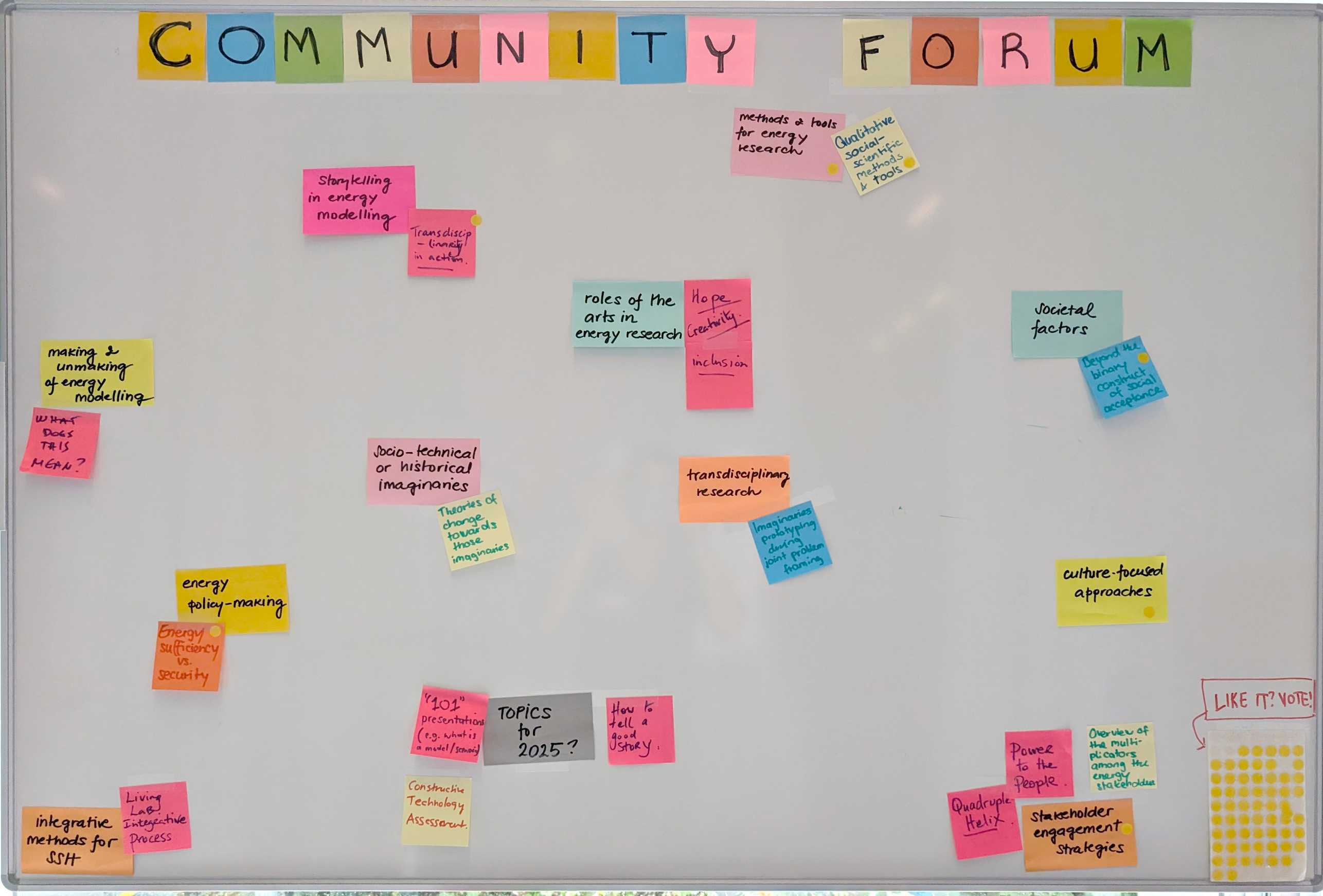
SSH Energy are participatory workshops (1 per year) organised by WP3 in relation to the “Social Science and Humanities Energy Research” workshops established in 2022. The overall aim is to open a space to integrate, discuss and reflect on the transdisciplinary and interdisciplinary collaborations elaborated each year in the Consortium. Stakeholders will also be invited to participate in at least one of the workshops. The team will use of different dialogue methods for knowledge synthesis, such as “Consensus Development Panels” (use scientific evidence to develop a statement on a research question or controversial issue by a panel of independent experts), or the “Most Significant Change Technique” (generate and analyze stories for monitoring and evaluating complex interventions) (MacDonald et al., 2009; Pohl & Wülser, 2019). This task is closely related with WP2 Task 2.1, in which the team will identify suitable cases for the toolbox. The workshops will serve as means to deepen the knowledge and expertise already present in the CoSi Consortium. Participant observation and content- analysis will serve as methods to identify a set of “boundary objects” that will inform Task 2.1 and other tasks in this WP.

Interested in this topic?
Check out our open Bachelor's and Master's thesis topics or read about ongoing doctoral and previous Master's theses below.
Or read our most recent blog post about it.
Doctoral Theses
Ongoing:
Co-creating Energy Futures: Integrating Arts, Humanities and Social Sciences in Energy Modeling
Doctoral candidate: Konstanty Ramotowski
Timeframe: August 2023 – August 2027
Abstract: The integration of Arts, Humanities, and Social Sciences (AHSS) into energy modeling has become a source of lively debate in the energy research field in recent years. It is seen as an opportunity for advancing models and improving their representation of reality, social relevance, and transparency. The interdisciplinary and transdisciplinary approaches in particular create opportunities for collaborations to emerge between AHSS and energy modeling communities, and to foster the co-creation process necessary for meaningful knowledge integration. In Switzerland, the calls for transdisciplinary energy research have made an institutional impact, leading to the development of projects such as ‘Co-evolution and coordinated simulation of Swiss energy system and Swiss society (CoSi, Funded by Swiss Federal Office of Energy, 2023-2033 period), in which my PhD thesis is framed. However, the role that Arts, Social Sciences, and Humanities have in energy research and the contribution these disciplines provide to our understanding of the energy transition is not yet fully determined. In my doctoral research project, I aim to investigate further socio-technical imaginaries and practices of the energy research community in Switzerland to understand how they shape the development of energy research and possible energy futures. Applying a cultural perspective to my research and using qualitative research methods such as literature review, in-depth interviews, and ethnography, I will delve into the current representation of ‘social aspects’ and the integration process of AHSS in energy modeling and the possible implications it brings for policymaking. These insights are expected to support decision-makers and contribute to a more informed policy-creation process in Switzerland.
Masters Theses
Ongoing:
Narratives of Resistance and Progress in the Swiss Wind Energy Transition: Policy, Popular Initiatives and Community Perspectives
Masters student: Cloe Compagnoni
Timeframe: April 2026 – October 2026
Abstract: This thesis aims to analyse the energy policy discourses developed in Switzerland regarding the expansion of wind energy and to understand the main narratives of key societal actors associated with these policies. Wind energy represents a potential solution to Switzerland’s structural electricity imbalance during winter, due to its favourable seasonal production profile. However, its deployment is constrained by lengthy administrative and legal procedures. This situation raises tension between different policy objectives, such as expanding renewable energy production and the preservation of the environment and democratic participation rights. Embedded within the COSI (Co-evolution and Coordinated Simulation of the Swiss Energy System and Swiss Society) project, this thesis uses a multi-method approach, including document analysis and semi-structured interviews. It examines policy documents and two recent federal initiatives “For the Protection of Direct Democracy in Relation to Wind Farms (Municipal Protection Initiative)” and “Against the Destruction of Our Forests by Wind Turbines (Forest Protection Initiative)” to understand the narratives used by federal authorities, initiative committees and affected communities. The findings aim to contribute to a better understanding of the governance of wind energy transition in Switzerland, with a focus on how narratives influence policy development, implementation and public acceptance.
Industry Actors in Energy Modelling: Involvement and Influence in Swiss Modelling Collaborations and Implications for the Credibility, Legitimacy and Salience of Model-Based Knowledge
Masters Student: Rebecca Weber
Timeframe: May 2026- November 2026
Abstract: This study examines collaborations between energy researchers and industry actors in the context of energy modelling projects in Switzerland. Energy models shape debates and decisions related to the energy transition by informing policymaking and public and private investment decisions. At the same time, they are not neutral representations of future energy systems but are shaped by assumptions, values and political choices. As energy modelling projects increasingly involve industry actors, it becomes important to understand how they shape modelling processes and outputs, especially given their strategic interests in future energy pathways and their key role in the energy transition.Embedded within the “Co-evolution and Coordinated Simulation of the Swiss Energy System and Swiss Society” (CoSi) project, this study investigates selected collaborations between modelling teams and industry actors in the ETH Energy Science Center (ESC) environment. It asks how industry actors are involved, how they shape modelling processes and outputs, and what this means for the perceived salience, credibility and legitimacy of model-based knowledge. Using a multi-method case study design, the thesis examines four selected collaborations through semi-structured interviews, document analysis, participant observation and a focus group discussion. The study aims to improve understanding of how researcher-industry collaborations shape model-based knowledge and what implications arise from this, while also generating insights for more transparent and reflective future collaboration practices.
Completed:
Fostering Stakeholder Engagement in the Development of Alpine Photovoltaic Projects: Best Practices and Challenges in Switzerland
Masters student: Paula Winkler
Timeframe: October 2024 - April 2025
Abstract: This thesis investigates how stakeholders are engaged in the planning phase of alpine PV projects in Switzerland. At a time when the Swiss energy transition must address a growing winter electricity gap, alpine PV projects are a promising solution. However, their success depends on public support. This thesis enriches the understanding of energy democracy by examining how new ownerships are negotiated in the concrete case of alpine PV. In Switzerland, as in many countries, the energy transition depends not only on technology but also on the people who have a seat at the table. At a local context, alpine PV offers new opportunities for social empowerment to decide their energy future, but these opportunities unfold within the social, political and institutional context in which they emerge. Using a transdisciplinary research framework, this study applies collaborative stakeholder mapping, semi-structured interviews, and a workshop with project developers to examine engagement practices across 17 large-scale alpine PV projects. Rather than evaluating engagement from the outside, transdisciplinary principles were applied as a methodological foundation to co-produce insights with stakeholders and embed justice considerations into the research process. This study makes three key contributions. First, it maps the diverse and interconnected stakeholder landscape. Second, it captures a snapshot of engagement practices at a pivotal moment in time, as the first solar PV projects are being built in Switzerland. Third, by analysing the emerging best practices and challenges, this study provides practical guidance to improve stakeholder engagement for future renewable energy projects. Findings reveal a limited culture of engagement, despite Switzerland’s tradition of direct democracy. This study argues that energy democracy in this context does not require full community ownership, but rather well-timed engagement throughout the project lifecycle. These insights contribute to ongoing debates on how to operationalise just energy transitions in emerging renewable technologies.
Bachelors Theses
Ongoing:
Completed:
Transdisciplinarity in practice: What is the potential of renewable energy communities in the energy transition of Switzerland?
Bachelors Student: Xenia Stocker
Timeframe: January 2025 - April 2025
Abstract: In 2019, the Federal Council of Switzerland initiated a long-term climate strategy aimed at achieving net-zero greenhouse gas emissions by 2050, in response to the escalating impacts of climate change. To support this initiative, the Swiss Federal Office of Energy (SFOE) launched the "Swiss Energy Research for the Energy Transition" (SWEET) program: “SWEET aims to accelerate innovations critical to implementing Switzerland’s Energy Strategy 2050 and achieving the country’s climate goals”. Additionally, the "Co-Evolution and Coordinated Simulation of the Swiss Energy System and Swiss Society" (CoSi) project was established. This bachelor thesis, conducted within the context of the CoSi project, investigates the potential of Solar Energy Communities in urban environments of Switzerland, using Zurich as a case study. The study aims to evaluate their contribution to achieving Switzerland’s climate goals. By using the canton of Zurich as a case study, conclusions drawn to be applicable to the broader urban context of Switzerland. It is justified to only focus on the urban areas, due to the higher electricity demands of urban areas compared to rural regions, which are not considered in this study. The primary objective of this study is to examine the integration of transdisciplinary approaches within Solar Energy Communities and to identify how these approaches can assist in overcoming the challenges faced by such communities.
The research methodology encompasses a comprehensive qualitative literature review on transdisciplinarity and renewable energy communities. Furthermore, semi-structured interviews will be conducted with individuals actively involved in renewable energy, experts on renewable energy communities and with representatives from EKZ (Elektrizitätswerk des Kantons Zürich) and EWZ (Elektrizitätswerk Zürich). Additionally, to the interviews, sites of Solar Energy Communities will be visited and walking interviews will be implemented. Those approaches are expected to provide valuable insights into the capacities, possibilities, and future prospects of Solar Energy Communities and the energy system in the canton of Zurich. Potential risks associated with the broad scope of renewable energy communities will be mitigated by narrowing the study to specific criteria, primarily focusing on solar energy and communities which are based in an urban area and namely located in the canton of Zurich. This study aims to provide a contextualized understanding of the potential and challenges of Solar Energy Communities in urban areas in Switzerland to contribute to net-zero ambitions. Emphasizing the transdisciplinary approaches that could be adopted to address these challenges. These communities could serve as exemplary models for integrating transdisciplinarity in bottom-up initiatives, offering valuable insights for future research.
Enhancing Transdisciplinary Collaborations in the Development of Wind Energy Ontologies
Bachelors Student: Amelie Foshag
Timeframe: April 2026- July 2026
Abstract: The Swiss wind energy sector faces a significant challenge: data generated throughout the lifecycle of wind farms exists in isolated silos, lacks standardised metadata, and remains largely inaccessible to AI-driven analysis. Ontologies, formal, machine-readable specifications of shared knowledge, are key to overcoming this fragmentation by enabling semantic interoperability across organisational and system boundaries.This bachelor's thesis is situated within the CoSi project, funded by the Swiss Federal Office of Energy's SWEET programme, and embedded in the WeDoWind open innovation ecosystem, a platform fostering secure data and knowledge exchange between research and industry. Within its Information Modelling Community, two key ontologies are currently being co-developed: the Wind Energy Domain Ontology (WEO) and the Operations Ontology. This process involves diverse actor groups whose collaborations has not yet been thoroughly examined.This thesis investigates how transdisciplinary collaborations among these actor groups are practiced and how they can be strengthened. Transdisciplinarity is treated as a guiding research paradigm, combining a three-phase model (problem framing, co-creation of knowledge, and re-integration) with the knowledge-regime heuristic, which makes differing values, epistemic assumptions, and actor constellations visible. The study follows a mixed-methods design: a role-based survey analyses the current state of collaborations across the cognitive-communicative and social-emotional dimensions. The findings are subsequently deepened through iterative participatory workshops employing the Storywall method, which surfaces individual and collective narratives of the collaborations process. The synthesis of these methods provides a deeper understanding of transdisciplinarity in the wind energy sector.
Outcomes: Deliverables for CoSi
Under the CoSi project, several deliverables have been published. You can read more about them below:
Outputs
ETH Net-Zero Day
We presented CoSi at the CSTS stand at the 2025 ETH Net-Zero Day. Learn more about our participation.
- Download Vienni-Baptista, B. (2025). Cultural Studies of Science and Technology Group Research and Teaching for Societal Transformations [Poster Presentation]. ETH Net-Zero Day (PDF, 264 KB)
- Download Ramotowski-Kula, K. (2025). How the knowledge on the Energy Transition is produced? [Poster Presentation]. ETH Net-Zero Day (PDF, 204 KB)
- Download Winkler, P.; Vienni-Baptista, B.; Schaffner C. (2025). Fostering Stakeholder Engagement in the Development of Alpine Photovoltaic Projects: Best Practices and Challenges in Switzerland [Poster Presentation]. ETH Net-Zero Day (PDF, 169 KB)
Project team
-

PD Dr Bianca Vienni-Baptista, Group Lead -

Dr Stephanie Briers, Established Researcher
-

Konstanty Ramotowski, Doctoral Candidate -

See full profiles of team members
Funding
CoSi is a research project sponsored by the Swiss Federal Office of Energy’s “SWEET” programme (Call 1-2022), start date June 2022.